
April 7, 2025
It’s Monday.

It’s been exactly three months since the fires. Three months since we left Pacific Palisades expecting we’d be gone overnight, and instead we’re starting a new life in a new town.
The first post-fire quarter is now over. I am thinking I’ll write this Substack for a year. There are nine months to go.
The current death toll from the Los Angeles fires is thirty. Thirty people. Their average age was 77.
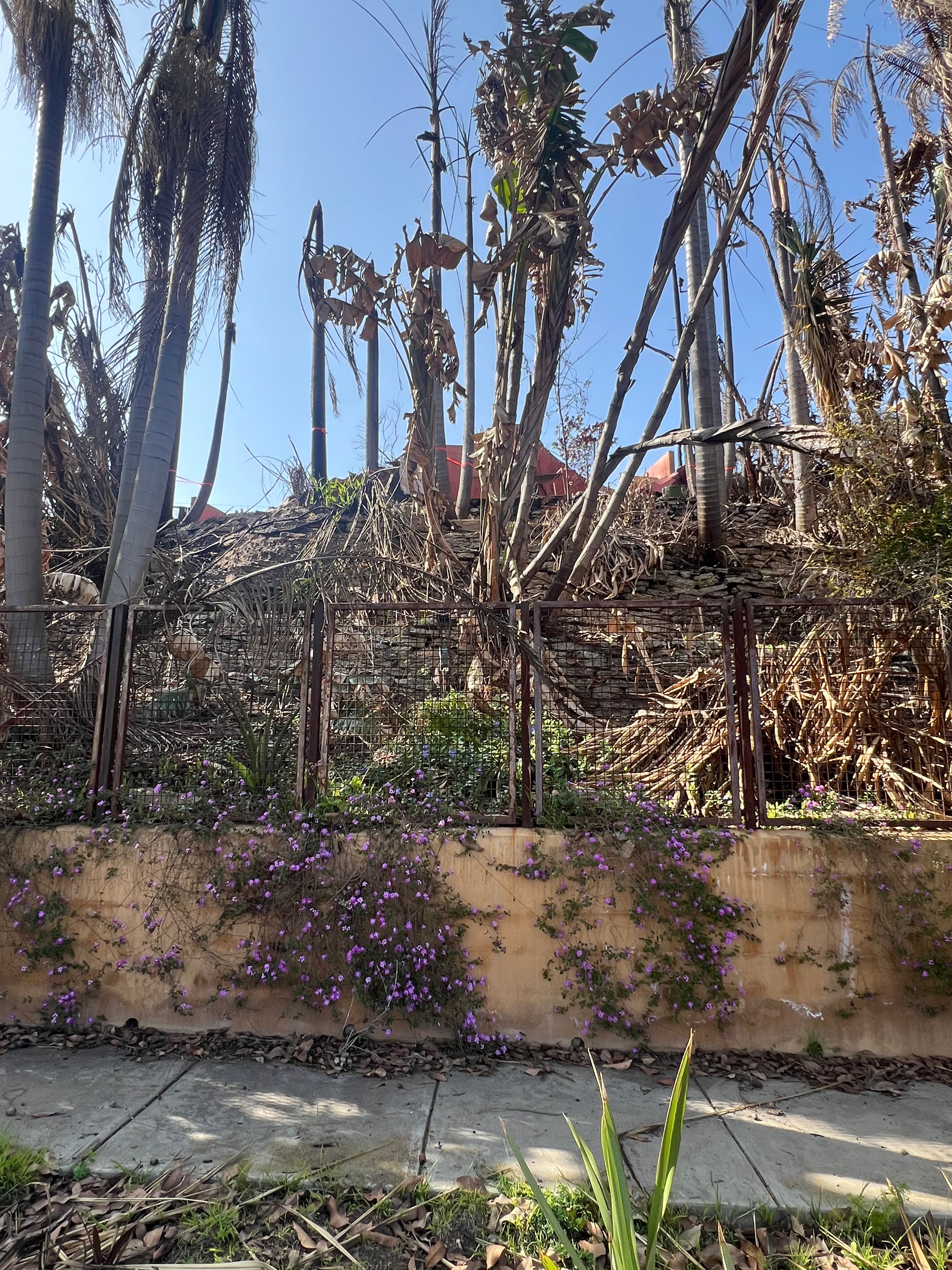
Catherine took a trip back to the remains of our house during her spring break. It seems all the other homes on our block have had their debris removed. Ours is the only one that hasn’t. The purple flowers along our gate are blooming again.
16-year-old Blaze now goes to high school in Santa Barbara on State Street. She is one of 5000 students who lost not only their home but also their school three months ago today. Blaze , like a lot of children, is having a hard time with that loss.
This photo essay about a neighborhood in Altadena that burned on January 7th pops up in my feed and strikes a cord.
My mother’s law firm signed a “friends of the court” brief on Friday in support of Perkins Coie’s fight with Trump.
The stock markets continue to fall in reaction to Trump’s tariffs. I don’t have any stock or any kind of retirement account but it seems pretty bad for those like my mother who do. We had a long discussion yesterday, before she left to take Blaze to get her nails done (we are working hard to distract Blaze and get her out of that dark basement) and then to drive back down to LA. George has designated several acts of protest as “performative.” Blaze agrees; the protests, the bumper stickers – they are all performative.
Blaze thinks what Cory Booker did, however, was NOT performative but disruptive and disruption is what those of us who are worried need to do more of. Blaze thinks we’re headed to civil war. My mother says, “I am 79-years-old. I can’t go to war. I can protest. This is what I can do.”
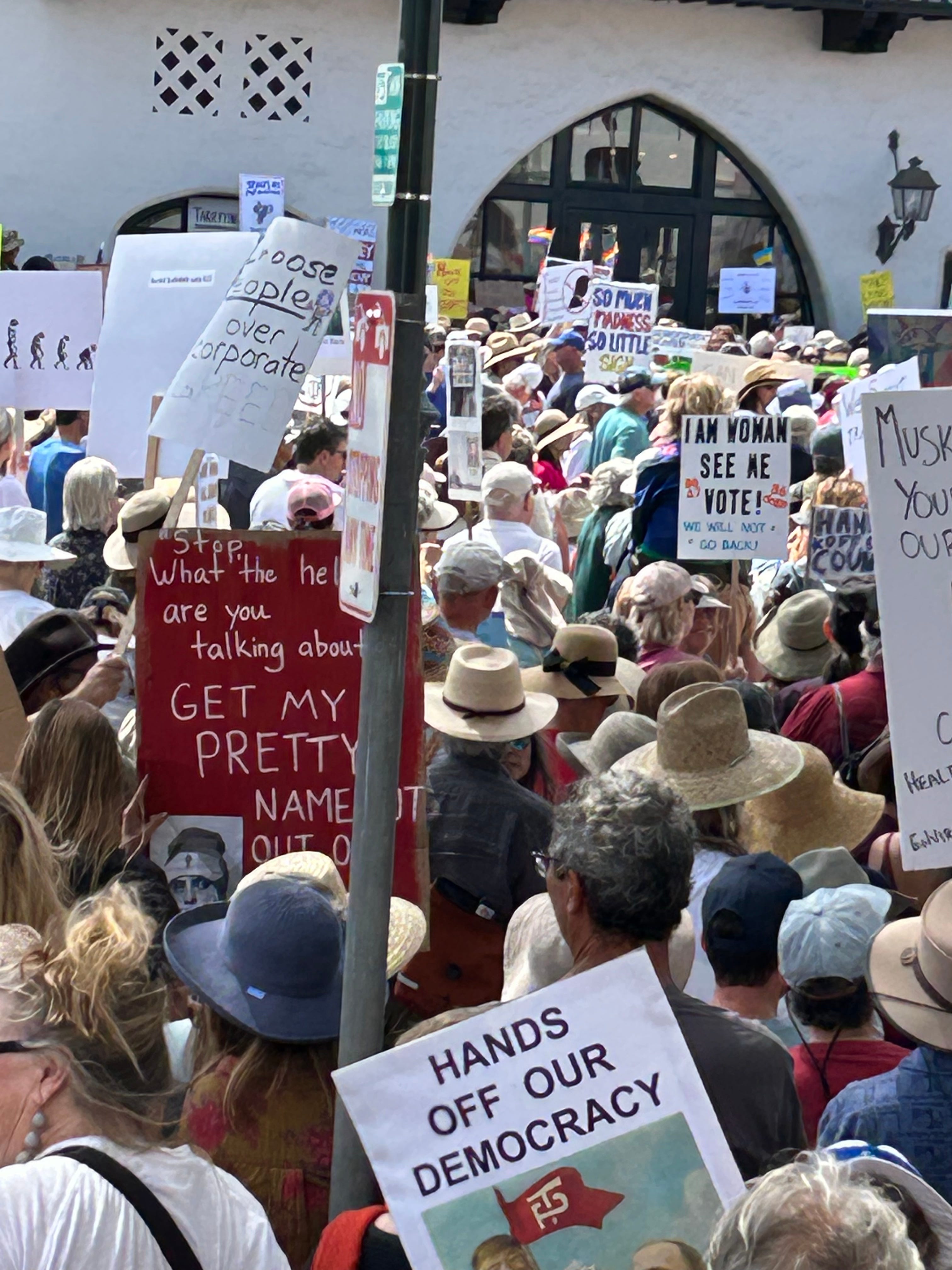
My mother sent pictures of the Hands Off! rally and march in Santa Barbara on Saturday. I couldn’t go because I was at my desk doing a virtual Q & A after a Vassar College screening of PLAN C. “What can we do?” one of the audience members asked me. As it relates to the film, I have a quick answer. “Buy abortion medication online, in advance. Buy it now while you still can. Plan for the worst. Have abortion medication in your medicine cabinet just in case someone needs it: you, your family member, a friend. Let them know you are a resource. Just in case.” While I am good at giving this advice, I have not done it myself. Not yet.
Like Blaze, George thinks we are entering a time of civil war. We all need to be prepared. The federal government could come at any time for any of us for any reason at all. I try to clarify, “Does that mean we are supposed to buy guns?” No, he is suggesting that we need to be careful. That if we resist or subvert or have a difference of opinion, we need to be measured about it and cautious speaking it as we could be snatched away in the middle of the night.
“I don’t want to be a ‘good German,’” I say. I want to resist. I want to speak out. I also still feel vulnerable, raw from so much personal upheaval. I’m not sure I can take up arms and be very effective.
There are still so many practicalities to deal with. I still have issues with a mailing address. A kind friend asks whether I received the care package she sent in January. Where did she send it? Oh that was our Airbnb; we left there on January 21. We have been living in this rental for over two months and will be for another nine months but we have a UPS box that is our permanent address. It’s where we have things like dog food sent, despite the inconvenience. Who knows where the care package went, but it did not find me. I text, “I am sorry!” She writes back that I am the most impacted person she knows from the fire and she is sorry her care package never made it.
Sometimes I think the confusion over where I live and where to send my mail is actually a safety thing. If “they” don’t know where I live, “they” can’t come and get me. This may be a plus.
I continue to think about what I can do to move forward, to get past this treading water, survival mode, hammock, limbo place and onto the solid footing of “next.”
I buy an off-the-shelf pair of reading glasses. I used to have multiple pairs around the house, so I wouldn’t ever be in a pinch. It’s hard for me to buy things like this in bulk now, so I am slowly building back my stockpile. The job of rebuilding, hustling funds from insurance, and buying things we have lost feels so self-centered. It is important psychologically, karmically, and spiritually that most of the hours in my day not be spent as a consumer or a customer.
While I am developing films that feel important, that work has been largely on pause for the past three months. I am taking meetings, re-introducing myself to the nonfiction industry, seeking advice, pitching to potential collaborators – but nothing is active. Is this all performative, I wonder? Appearing to be busy, talking about the work, being around the work without actually doing the work? When does it shift to being productive or at least to feeling productive?
Sometimes, lying in bed, I swipe around Substack and I see other accounts. Last night, a woman from St. Louis, who is basically my age, writes that she is starting over. I’m not sure why. I need to spend more time reading her posts, but I think it’s because of her age. There are stages of life where what we do is for other people – because it’s expected of us or needed from us. This is especially true for women. At some point, is it possible, and suitable, to turn your attention to yourself? To what YOU want? (Is this what is referred to as a mid-life crisis?)
Many people are in limbo for all kinds of reasons. In a way, looking back, I was in a limbo place before the fires. I think this is why it seems particularly hard to find my footing now, with this extra empty space the fires have created.
I think to myself - sure. What I am doing now is reflecting. I am naval-gazing. I am looking inward. But there’s only so much juice there. What do I want? So many things. World peace. A garden. A couple of dresses. To get back into shape. To recover from the eating extravaganza that was spring break.
Even as I write this Substack, I think, “They [you] don’t want this stream of consciousness stuff. They want scenes.” It’s like my filmmaking work. You can’t just have exposition, you need scenes: your hero out in the world; scenes of preparation; scenes of action; scenes of aftermath. SCENES. What are the “ah ha” moments? They started out as X, and then something happened and they became Y. This is how they changed.
I look back at the chronology of how I got here. It started with an ordinary day. That was our X. Smoke on the ridge. How many times will I look back at that moment: my curiosity at the distant grey, wondering about the direction of the wind as if we could tell by the leaves of the palm trees, thinking we were safe. We now know we were not safe, but we did not know it then. We know what happened next: the scenes. The fires, the evacuation, the Airbnb, this rental house, the Disaster Recovery Center. What is our Y that these scenes are leading up to?
I have told you about “here,” this new place. The church bells that ring every morning at 7:43. They rang again this morning. I’ve told you about the dogs sleeping on the bed, watching me as I write. I’ve even described the bird that often pecks at my window, for minutes at a time, as if he is trying to tell me something. There are beaches here. The toxic algae bloom seems to be over.
I have shared some of the struggles with Blaze, about George’s online shopping and deal hunting, about our heated conversations over architecture.
We are all on different timetables with this. The experience is not fully cooked.
As George sketches different designs and then realizes there is no place to do laundry or to put a toilet and then revises the design, I ask him about the things he used to want to put into our home, before the fire. He always wanted to remodel the kitchen. He talked incessantly about a booth. Where’s the booth I ask?
There is none, he says.
But you always wanted a booth!
There are a lot of things I used to want, he says.
At our last meal before our daughter Catherine went back to college on Saturday after spring break, I asked the question, “How do you think we have changed since the fires? How are our post-fire selves different from our pre-fire selves?” No one had a solid answer. Catherine tried to say something about how she was maybe a little less uptight (I think that was the gist of it). We observed that George was sometimes friendlier. He is certainly more talkative at dinner post-fire than he was pre-fire. He has more stories to tell. I don’t know about the rest of us. I don’t think my mother answered the question before the subject was changed. Blaze was not there; she was in her basement.
Me? I guess so far, I would say there is less vanity. I have nowhere to hide. I have stopped pretending to be someone I am not: younger, more prolific, more accomplished, more confident, more certain about it all. In our narrative grief class, Susie said we who have lost our homes in the fire are more open-hearted. Yes. We have no choice. The stripping away of things and stuff - walls and architecture, shoes, jewelry, history - we are more naked. We are more raw. What is left are our bodies, however reshaped – our broken hearts open, maybe, but eager to be made whole.
None of us will be who we once were.
I think that’s true.
Perhaps this post-fire me is simply more honest?