
December 7, 2025
All we did last December and throughout our lives up until this point, blissfully unaware about what would happen on January 7th, 2025.

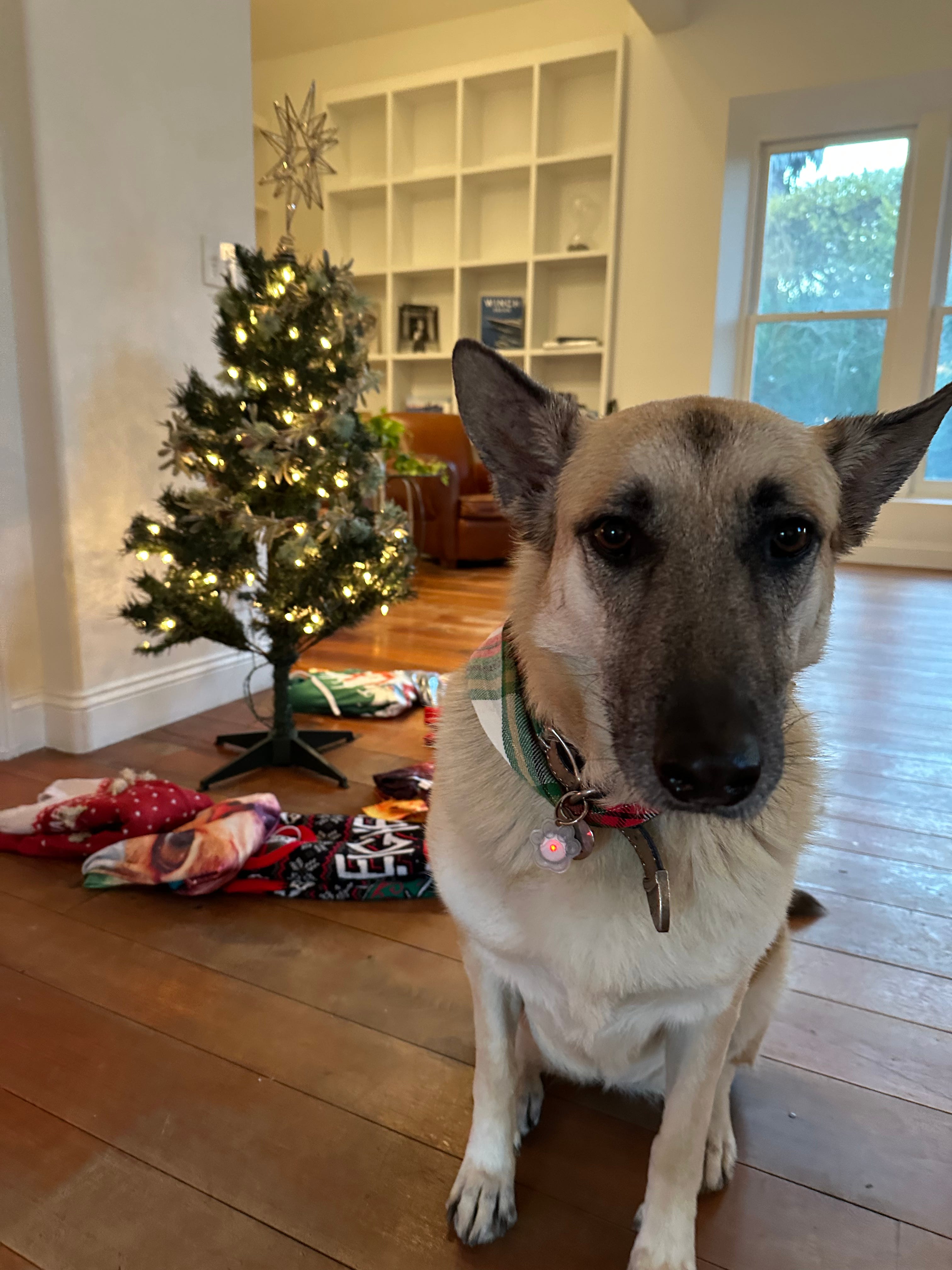
Turns out, there are a lot of triggers this time of year. Yesterday, Catherine was lounging on the couch, watching “Cheaper By The Dozen” while she recovered from an end-of-year formal the night before. One of the dozen kids had a frog that got loose. The snow melting off the roof sometimes sounds like Blaze’s frogs, the way they used to croak. My phone reminds me of the walks the dogs and I used to take to my mother’s. How Milo would perk up his ears when I asked, “Do you want to go to Dabu’s?” (Below is from December 17, 2024.)
We had such high hopes in December 2024, playing with the new Karaoke machine. Would we have done anything differently had we known?
George had just assembled that weight machine in the garage. We would all be so fit in 2025. We all had so many goals and ideas for our year ahead.
All we did last December and throughout our lives up until this point, blissfully unaware about what would happen on January 7th, 2025.
We didn’t know that in X days. X hours…We didn’t know how everything would change. How we would change. We didn’t know how we would become different people, grieving, rebuilding in our own ways, on different timetables - needing face cream or pillows or cross-country drives. Needing alone time. Together time. Lots and lots of dog walking. Digging ourselves out of the wreckage to be new, someone we didn’t yet know.
We didn’t know how much we had built and how much we had lost until we started to imagine rebuilding and moving forward. And then sometimes that process needed to stop. Just stop. So our hearts and minds could catch up. So we could get to know the new person we had become.
It has now been eleven months since we saw smoke on the ridge. Some of the chronology gets mushy. Not when we left - we have timestamps on our phones for that - but after we left, what happened then? When exactly did our house burn? How many hours later?
My father-in-law writes me: Your piece today made me think of something Kierkegaard said: “Life is not a problem to be solved, but a reality to be experienced.”
My horoscope for today tells me: “Practice letting go of the need to have everything figured out perfectly. Sometimes moving forward with what you know right now is better than waiting for ideal conditions that may never arrive.”
My 56th year. A year of contemplation and licking my wounds. Very few solutions and figuring things out. A lot of moving around.
There was something about having stuff that not only took up space, but also made me more confident. The stuff reminded me of the places I’d been, what I had accomplished. The stuff was both protective and sustaining - armor and memories.
When I walk here in the Berkshires, ignoring the signs that tell me to stay on the path and walking through soccer fields that are covered in freshly fallen snow without even a footprint, I just keep thinking: this is a blank slate, this is a blank slate.
The snow sparkles in the sun. Walking is good. It clears the head. My mother talks about pushes and pulls. I’m not sure I feel either just yet. I wonder what she has decided and based on what?
In eleven days, I will start my cross-country drive, still trying to claw my way out of this. Have structure. Be productive. Get a job. I’ve tried to coerce people to come with me on the drive but I haven’t gotten any takers just yet. Wichita? Amarillo? I could swing by and pick you up at the airport?
Blaze and George tried out mattresses in a showroom in Ventura. They have questions for me. Was I weirded out buying mattresses on display? Showroom models? No, I answer - they were all showroom models. Five sets of mattresses and box springs. One even had a water-stain from the warehouse. Deep discount.
Blaze has a year-end assignment for her English class. Her school gives pluses with their grades. Blaze has an A+. This is new for Blaze. This is hard-earned. There is more here - but it is Blaze’s story to tell someday, as she chooses.
The year end assignment is about my story, and her father’s, and my mother’s. She has picked the three of us to interview. The three questions are:
1 How did the era you grew up in shape your perception of the world?
2 Do you have any regrets about things you wish you had done differently?
3 Is there one major event that has changed your way of thinking, or has your personal development been more of a gradual, consecutive process?
This is a bit heavy. In summary, my answers were yes, yes, yes, and yes. Because of the 3-hour time difference, it was late last night when we Zoomed. I told her we should follow up in the morning, in case I had more to add or she had follow-up questions.
More fully, in answer to the first question, I said that the era shaped me deeply. Growing up when the Vietnam War was still being fought, in Berkeley with backyard hot-tubs, wine-tasting, and pot-smoking and then the Erhard Seminar Training when the language suddenly changed - “Get off it. Don’t be a victim. Be the change you want to see.” I preferred my grandparent’s house in Missouri, where life made a lot more sense and had a routine to it, even amidst their grief.
In answer to the second question, I have regrets about all the crap jobs I took in my twenties and early-thirties, just to pay the bills. I feel like I wasted a lot of time and my career would have had a lot more momentum to it if I hadn’t done that. I wish I had taken more risks along the way – and perhaps that I still took more risks. I also regret not talking more to my grandfather before he died – about his experience in World War II and also about my father. I also wish one of us had evacuated with the frogs.
In answer to the last question, I said, yes, I’ve had many “before” and “after” moments: losing my father in Vietnam which changed my entire life and the trajectory of my family; finding the article about his death that propelled me on the journey to make a film about his life (which was my first documentary); when Catherine was born and I became a parent for the first time; when Blaze was born and I became a parent of two; the fire. There are certainly more events. But these were the five, line-in-the-sand moments that were not gradual but single moments in the timeline of my life where everything changed on a dime. I also answered that there has been gradual development, too.
I told Blaze a story she had never heard about how my father had been born when my grandfather was serving overseas in the Army and my grandfather didn’t even meet him until my father was three or four. My father had been raised by my grandmother and two aunts, who were doting. But when my grandfather came back after the war, the rules changed. My grandmother told me that after my father was killed, my grandfather regretted being such a strict father and how hard he had been on his son.
As I unpacked this story with Blaze last night, I recognized that perhaps my grandfather wouldn’t have felt that same regret if my father had lived. Perhaps some regret is also tied not so much to our own actions, but to things that happen in life that are beyond our control.
Would I have the regret about my career if so much of my work hadn’t burned?
For some reason, over the past week, the theme of regret keeps coming up. What does one do about it? What purpose does it serve?
Apparently, my father-in-law had lunch with Blaze and the conversation was also about regret. How we may now, as a society, medicate against it but for 2,000 years Greek philosophers have written about regret’s “use.” I asked Blaze, “So what is its use? What do we do with it?” She rattled off some philosophers’ names but not their ideas.
When I do a quick Internet search, which is admittedly not the way I should bone up on ancient Greek philosophy, the results mostly seem to support the notion of living a life without regret. I change my query: What is the value of regret?
It seems Aristotle, Epictetus, and Plato all viewed regret as an emotion that could guide one to do better next time, to make future choices that are more aligned with the true self and moral compass. As this year winds down, I will think more on this: regret, and experiencing life and regret without trying to solve it. There has to be a sweet spot where these notions coexist: having regret, experiencing life and grief in the moment, all with an open heart.
Tracy!!! Do you have a book deal yet? Your writing is so good and your story feels so important because it captures how it feels to live to right now (mid 2020s America). Even for us who haven’t lost our homes, it feels like any of us could lose everything at any moment. Your story resonates to the post Covid, Trump, climate change, mass deportations, instability, fear and chaos vibes we are all dealing with while also being a story about a family. At the end of the day, your story is about love and that’s the most powerful and important force in the world.
Tracy- if you end up driving through Wichita either way, let me know! I’d love to take you for dinner and share some conversation xo
. 💕💕💕